
About Us
News & Events
Additional Info
Membership
Members Only
- Member Directory
- Ivy Leaves Magazine
- E-Ivy Leaf Newsletters
- National Officers
- Chapters
- Committees
- History Center
- 4ID Bibliography
- Guestbook
Superusers Only
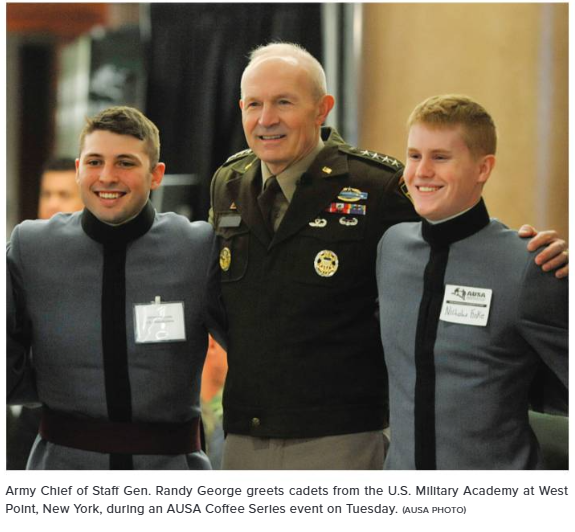
Leveraging new technology more quickly has become the bedrock of the Army’s effort to modernize its equipment, manage its formations and change cumbersome acquisition processes, Army Chief of Staff Gen. Randy George said.
By harnessing the momentum of continuous transformation and partnering more closely with industry, the Army is accelerating several key programs vital to its success on a modern battlefield. George cited as an example the M1E3 Abrams tank. The first prototype of the next-generation tank was unveiled in mid-January at the Detroit Auto Show.
The M1E3 tank “can knock out a target in a tenth of a second at a quarter mile,” George said, adding that “what’s most exciting about this for the Army is this is a tank we have produced six years ahead of schedule.”
Equally exciting is that the tank is modular, has an active protection system and is 25% lighter than the Army’s legacy Abrams tanks, George said Jan. 20 at a Coffee Series event hosted by the Association of the U.S. Army. Additionally, several companies are working on the tank’s software systems, he said.
“That’s the way of the future here—nothing should take us five to seven years to produce,” George said.
During his remarks, George also highlighted several other technological leaps that are taking place across the service. Chief among them is Next-Generation Command and Control. Known as Next-Gen C2, the program seeks to provide the integrated information framework that commanders need to make rapid decisions across warfighting functions, according to an Army news release. It also will give Army tactical units lighter, more mobile and survivable network and command and control equipment, according to the service.
Leading the charge on testing Next-Gen C2 are the 4th Infantry Division at Fort Carson, Colorado, and the 25th Infantry Division at Schofield Barracks, Hawaii, each working with up to six different companies. The concept, George explained, is that leaders can take a tablet or their laptops to their vehicles “and go directly to the battlefield, and you can do everything,” he said.
“In our view, there’s no such thing as a business system, these are all readiness systems, and they should be systems that are intuitive, easy to use, that travel with our soldiers,” George said.